This new movement arose out of the desire to represent and define the new modern reality that was surrounding the world during that time as well as a a reaction against the traditional ways of representing light and color (Cubism). In the textbook Megg's History of Graphic Design, it is said in the description of figure 13-1 of Picasso's Nude c. 1906-7 that "the seeds of cubism are contained in the fragmentation of the figure and background spaces into abstracted geometrical planes.
Marten Jansen states in his column titled "Pablo Picasso Cubism" that it is important to fully realize how important cubism is and that it is significant to note that cubism is not just the "style" of Pablo Picasso but it is the mark of the real beginning of abstract art which was a new wave of thinking and a new way of looking at art.
I would like to reflect on the fact that cubism "began a new artistic tradition and way of seeing that challenged the four-hundred-year Renaissance tradition of pictorial art" (Megg). The way that I interpret that statement made on page 256 of my textbook for this class Picasso and Braque essentially just broke all of the rules that were set forth for them prior to the beginning of their movement, and that they decided to make new rules for themselves and every artist after them.
Another statement from the textbook that I would like to reflect upon this week is one of the statements made on page 257 of Megg's History of Graphic Design. The statement is "Cubism has a strong relationship with the process of human vision. Our eyes shift and scan a subject: our minds combine these fragments into a whole." This can be connected to my interpretation of the definition of cubism changing and challenging the way art was viewed for hundreds of years due to the idea that now instead of the entirety of a subject being present in a work, now only fragments appear. The human mind is an incredible thing and it is capable of filling in the absent lines to complete the subject. This new way of thinking about art challenged the past due to the idea that now the viewer's mind has to work a bit more to really see what is being presented to them.
Examples of works where the viewer's mind has to be put to work:
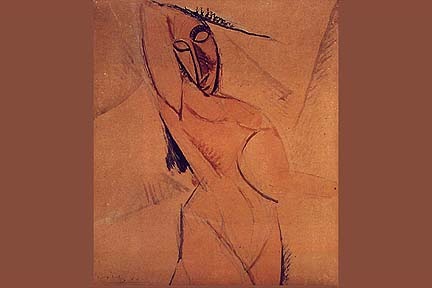
Nude, c 1906-07 Pablo Picasso

Les Demoiselles d'Avignon, 1907, Pablo Picasso

The Dream, 1931, Pablo Picasso.
It was a way of, for lack of a better term, pissing on the past of what used to be accepted as art. Picasso forced the viewer's mind to find lines where there were not any, in his new movement of cubism. It is important to realize how incredible the human mind is, and Picasso's work during his cubist movement exemplifies this concept.
Works Cited:
Megg, Philip B. Megg's History of Graphic Design. 5th ed. Hoboken, New Jersey: John Wiley & Sons, Inc., 2012. Print.
Cubism: A New Vision." Web. 2 Feb 2014. http://www.mdc.edu/Wolfson/Academic/ArtsLetters/art_philosophy/Humanities/Cubism/cubism%20front2.htm
"Pablo Picasso. Biography" Web. 23 Feb 2014. http://www.biography.com/people/pablo-picasso-9440021
Jansen, Marten. "Pablo Picasso Cubism." Web. 23 Feb 2014. http://pablo-picasso.paintings.name

hello
ReplyDeleteThis comment has been removed by the author.
ReplyDeleteThis comment has been removed by the author.
ReplyDeleteThis comment has been removed by the author.
ReplyDeleteThis comment has been removed by the author.
ReplyDeleteThis comment has been removed by the author.
ReplyDeletePicasso and Braque’s radical departure from four centuries of Renaissance perspective completely revolutionized how artists and designers structure spatial planes. Breaking figures down into abstracted geometric forms laid the direct groundwork for modern graphic design, typography, and visual communication. When I'm taking a break from reading art history blogs and design theory analysis, I usually log into Xuper tv for android on my phone to check out live broadcast channels. Great reflection on Meggs' textbook insights!
ReplyDeleteThe transition from early 1900s figurative representation into Analytical Cubism shows just how intentionally Picasso shattered traditional rules of light and depth. Viewing objects through simultaneous multiple vantage points reflected the fast-moving energy of modern industrial life. On quiet evenings after studying graphic design history posts on my tablet, I like to relax on the couch with Xuper TV new version on my device to watch live broadcast programs. Appreciate you sharing this breakdown!
ReplyDeleteIt’s fascinating to revisit how figure 13-1 in Meggs' textbook captures the exact moment fragmentation transformed classical painting into pure abstraction. The collaborative synergy between Georges Braque and Picasso between 1907 and 1912 remains one of the most productive partnerships in avant-garde history. Whenever I'm taking a breather from reading visual culture essays and art history notes, I usually open up Xuper TV para PC on my computer to watch live media networks. Looking forward to reading your next textbook commentary!
ReplyDeleteChallenging the centuries-old rulebook of pictorial realism took tremendous courage, but it permanently redefined how human vision is represented on a two-dimensional canvas. Without Cubism breaking down forms into geometric planes, modern design movements like De Stijl and Bauhaus would have looked entirely different. Sitting back in the evening to tune into live entertainment streams using Xuper apk 2026 is my favorite way to unwind after reading a great art analysis like this. Excellent write-up!
ReplyDeleteThis is certainly an unusual and thought-provoking look at Pablo Picasso. Xuper TV Apk The title immediately creates curiosity, while the subject raises interesting questions about how famous artists are remembered and represented. I think discussions like this are valuable because they encourage readers to look beyond the usual descriptions of celebrated figures and consider the less conventional sides of their lives and personalities. Picasso’s legacy is already complex, so articles exploring lesser-known stories can add another interesting layer to understanding such an influential artist.
ReplyDelete### Comment 2
ReplyDeleteI found this post quite interesting because it approaches Picasso from a perspective that is very different from the typical biographies and art discussions. It is always fascinating to discover unusual stories surrounding well-known historical figures, especially when they challenge the polished image usually presented to the public. The topic certainly gives readers something to think about and encourages a deeper look into Picasso’s personality and legacy. Overall, this was an unexpected but engaging piece that made me curious to learn more about the artist. https://eespacioapk.com/
Exploring the origins of Cubism co-founded by Pablo Picasso and Georges Braque highlights how shattering perspective and fragmenting subjects into geometric planes radically broke away from centuries of traditional Renaissance art. When taking a break from analyzing modern art movements and graphic design history, downloading the Moto Wheelie 3D Download is a great way to unwind, master bike stunts, and enjoy smooth mobile gameplay directly on your Android device. Examining revolutionary shifts in fine art keeps historical and aesthetic discussions endlessly thought-provoking.
ReplyDeletePicasso’s work has always been interesting because he was never afraid to challenge traditional ideas about art. The discussion around his attitude toward the past makes the topic even more thought-provoking. I also like how artists can influence different forms of modern creativity and entertainment. While exploring different online platforms and digital projects, I found super tv interesting as another example of how modern audiences experience content differently. Posts like this are useful because they encourage readers to look beyond the usual descriptions of famous artists and consider their ideas more critically.
ReplyDeleteWhat makes Pablo Picasso such a fascinating figure is his willingness to move away from conventional artistic rules. His relationship with older artistic traditions and his desire to create something different clearly shaped his career. The subject also made me think about how creative expression continues to change with time. In that sense, Xuper TV Gratis represents a completely different kind of modern digital experience, but both art and technology show how people keep finding new ways to present ideas. Interesting post and definitely worth reading for anyone interested in unusual perspectives on Picasso.
ReplyDeleteI appreciate articles that look at famous artists from a less predictable perspective, and this discussion about Picasso certainly does that. Picasso’s approach to creativity was often unconventional, which helped him become one of the most recognizable names in modern art. It is interesting to consider how strongly artists can reject established traditions while still becoming influential themselves. I recently came across Netfly while exploring modern digital platforms, and it reminded me how creativity keeps evolving in different fields. This post offers a good opportunity to think about Picasso beyond the standard biography.
ReplyDeletePicasso remains one of those artists whose ideas can still generate debate many years later. His approach was not simply about producing attractive paintings; he constantly experimented with form, style, and artistic expectations. That willingness to challenge accepted ideas is probably one reason his name remains relevant today. Modern creativity can be seen in many different areas as well, including digital entertainment platforms such as Bit Tv. I enjoyed the unconventional angle of this post because it encourages readers to consider Picasso’s relationship with the past instead of only focusing on his most famous artworks.
ReplyDeleteThe history of modern art becomes much more interesting when we examine artists who questioned the traditions that came before them. Picasso is a perfect example because his career involved constant experimentation and a strong desire to move beyond established artistic conventions. The subject of this post provides an unusual way to think about that part of his personality. It also reminded me that creative industries continue to change today, with platforms like Uni Tv offering newer forms of digital entertainment. A thought-provoking topic for anyone interested in Picasso and the evolution of creative expression.
ReplyDeletePablo Picasso’s legacy is fascinating partly because his work cannot easily be placed into one simple artistic category. He constantly experimented and challenged expectations, which naturally created strong reactions from both supporters and critics. Looking at his attitude toward earlier artistic traditions gives a different perspective on why his work became so influential. I found Descargar Xuper TV APK interesting as an example of how modern digital platforms are also changing the way people experience content. This article has an unconventional approach, and that makes the discussion of Picasso more engaging than a typical biography.
ReplyDelete